
Why European Businesses Need ISO 27001 Amid Rising Cyber Threats (2026 Guide)

Computer attacks are growing fast in Europe. Businesses in the UK, Germany, and Italy face new dangers every day. Bad guys steal information or lock computers so you cannot use them. They even try to attack through other companies.
Because of this, ISO 27001 is not just a fancy certificate anymore. It is a real way for companies to stay safe and keep their customers happy. This article explains why European businesses are choosing ISO 27001 in 2026. We will look at why attacks are getting worse. We will also see how it helps companies follow the rules and share real stories of success.
The Current Cyber Threat Landscape in Europe
Europe is a big target for computer crimes. Reports show that attacks went up a lot in 2025. In the UK, businesses had over 2 million problems last year. Germany faced the same trouble, especially in factories and hospitals. In Italy, bad guys attacked small businesses even more than before.
These attacks are not random. Criminals look for valuable things like customer names, secret ideas, and money details. Fixing just one attack can cost a huge amount of money.
This is why ISO 27001 is so helpful. It gives companies a clear plan to stay safe. Instead of waiting for a problem to happen, this plan helps stop the bad guys before they get in.
The Strong Connection Between ISO 27001 and GDPR
GDPR is still the biggest data protection regulation in Europe. Article 32 requires organisations to implement “appropriate technical and organisational measures” to ensure data security. ISO 27001 helps prove exactly that. Its Annex A controls map very closely to GDPR requirements. For example:
- Access controls and encryption support data security obligations
- Incident response processes help meet the 72-hour breach notification rule
- Risk assessments align with GDPR’s DPIA (Data Protection Impact Assessment) requirements
Many supervisory authorities across the EU now view a certified ISMS as strong evidence of GDPR compliance. In the UK, the ICO often looks favourably on ISO 27001 when assessing accountability. In Germany, BaFin and state data protection authorities frequently reference it during inspections. Italian companies use it to demonstrate compliance with the Garante.
In short, implementing ISO 27001 is one of the smartest ways to reduce GDPR risk and show regulators and clients that you take data protection seriously.
Market Growth – The Numbers Behind the Demand
The global ISO 27001 certification market is growing quickly. It is projected to expand at a compound annual growth rate (CAGR) of 11.5% from 2025 to 2030. In Europe, growth is even stronger in certain sectors. UK and German companies are driving much of this demand. Many are motivated by new client requirements and stricter insurance conditions. Italian SMEs are catching up fast, especially in manufacturing, medtech, and fintech, where supply chain security is critical.
This growth is not just about regulation. It reflects a broader shift: European businesses now see ISO 27001 as a competitive advantage. Clients prefer suppliers who can prove they manage information security properly. Certified companies often win tenders and close deals faster.
Real Case Studies from European Businesses
Let’s look at three real-world examples.
Case 1: UK SaaS Company
A London-based SaaS provider with 85 employees wanted to expand into enterprise clients. They faced repeated questions about security during sales calls. After implementing ISO 27001, they won three major contracts worth over £1.2 million in the first year. Their cyber insurance premium dropped by 22%.
The biggest benefit? The internal team now manages security confidently instead of reacting to incidents.
Case 2: German Manufacturing Firm
A mid-sized manufacturer in Stuttgart supplied automotive parts to several large OEMs. The clients demanded ISO 27001 as a condition of continued partnership. The company completed certification in 9 months. They discovered several weak access control practices during the gap analysis. Fixing them not only helped with certification but also reduced internal data leakage risks.
Case 3: Italian MedTech Startup
A company in Milan providing traceability solutions for medical devices needed to prove GDPR compliance to EU clients. They chose to implement ISO 27001 alongside GDPR requirements. The integrated approach saved them significant time and money. Within six months of certification, they secured two major contracts with European pharmaceutical companies that had previously hesitated.
These examples show a common pattern: ISO 27001 helps European businesses reduce risk, win trust, and grow.
What European SMEs Should Consider Before Starting
European SMEs face some unique challenges when implementing ISO 27001.
- Resource constraints — Small teams often wear many hats.
- GDPR overlap — They need a system that satisfies both standards without duplication.
- Local requirements — In Italy, Accredia expects detailed documentation. In Germany, DAkkS focuses heavily on evidence of implementation.
- Language and culture — Clear communication is essential, especially when working across borders.
A good consultant or structured guide can help overcome these hurdles.
Step-by-Step Implementation Overview for SMEs
Here’s a simplified roadmap many successful European SMEs follow:
- Leadership commitment — Get buy-in from the top.
- Define the scope — Decide what the ISMS will cover.
- Gap analysis — Understand where you stand today.
- Risk assessment — Identify and prioritise risks.
- Implement controls — Focus on Annex A controls that matter most.
- Training and awareness — Make sure people understand their role.
- Internal audit — Check that everything works.
- Management review — Leadership reviews progress.
- Certification audit — Stage 1 and Stage 2 with an accredited body.
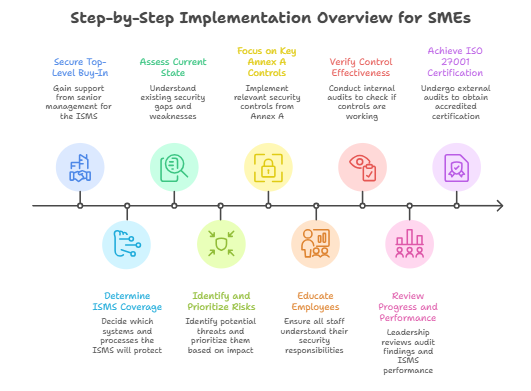
The whole process typically takes 6–12 months for SMEs, depending on size and starting point. Every point is discussed in detail below:
Step 1: Get Leadership Commitment
Everything starts at the top. Top management must show genuine support for the ISMS. This is Clause 5.1 of the standard. The boss needs to approve the information security policy and make sure the team has time and budget. Without this, the project usually stalls.
In practice, many SMEs in Germany hold a short management meeting. They explain why ISO 27001 helps with GDPR Article 32 and client tenders. UK companies often link it to cyber insurance discounts. The key is to make security part of normal business decisions, not an extra task.
Step 2: Define the Scope of Your ISMS
The scope answers one simple question:
Which parts of the business does this ISMS cover?
Write a short, clear statement. Include locations, departments, systems, and data types. Mention any exclusions and why they exist. European SMEs often start narrowly. A Berlin SaaS startup might scope only its cloud platform and development team. An Italian manufacturing firm might limit it to production systems in one factory.
Tip: If you process EU personal data, include it explicitly in the scope.
This makes GDPR Article 32 compliance much easier to prove later.
Step 3: Carry Out a Gap Analysis
Do not skip this step. A gap analysis compares your current practices against the full ISO 27001:2022 standard. A good one reviews policies, risk registers, access controls, and incident processes. It interviews staff from different departments. It produces a clear report with prioritized actions.
Typical cost in 2026:
UK: £3,000 – £8,000
Germany: €3,500 – €9,000
Italy: €4,000 – €10,000
This early investment saves money later. Many SMEs discover they already have 60–70% of the controls in place.
Step 4: Perform Risk Assessment and Treatment
Risk assessment is the heart of ISO 27001. You must identify information assets, threats, vulnerabilities, and potential impacts. Keep it simple. List assets like customer data, financial records, and cloud systems. Rate risks by likelihood and impact. Then decide how to treat each risk: accept, avoid, mitigate, or transfer.
Common gap in European SMEs:
Weak access controls. Many companies still share passwords or give everyone admin rights. Under ISO 27001, you must limit access to “need-to-know” only. This also helps GDPR Article 32 by reducing unauthorized access risks. Document everything in a risk register and create a Statement of Applicability (SoA). The SoA lists the 93 Annex A controls and explains which ones you use and why.
Step 5: Develop Policies, Procedures, and Controls
Write clear policies and procedures. Focus on what people actually do every day. Key documents include:
- Information security policy
- Access control policy
- Incident response plan
- Data backup and encryption rules
Implement the chosen Annex A controls. Start with the basics: strong passwords, multi-factor authentication, secure backups, and regular patching. In Europe, many SMEs also map these controls to GDPR requirements. This single set of documents satisfies both standards and saves time.
Step 6: Provide Training and Raise Awareness
Security only works if people follow the rules. Train all staff on the policy and their specific responsibilities. Keep sessions short and practical. Use real examples: “What do you do if you receive a suspicious email?”
European SMEs often combine this with GDPR training. It shows staff why both frameworks matter for the business.
Step 7: Run Internal Audits and Management Reviews
Before the external audit, carry out your own internal audit. Check that controls are working and the ISMS is effective. Management must review the ISMS at planned intervals. They look at audit results, incidents, risks, and improvements. Document everything. Auditors want to see that leadership is involved and the system is improving.
Step 8: Prepare for Certification and Choose the Right Body
Choose an accredited certification body (UKAS in the UK, DAkkS in Germany, Accredia in Italy). Book Stage 1 (documentation review) and Stage 2 (implementation check) audits.
Many SMEs in Europe use the same consultant for implementation and then switch to an independent auditor for objectivity.
.
Return on Investment – Why It’s Worth It
Many European SMEs report clear benefits within the first 12–18 months:
- Access to new enterprise contracts
- Lower cyber insurance premiums (often 15–25% reduction)
- Faster supplier and partner approvals
- Reduced risk of data breaches and fines
- Stronger internal security culture
The standard helps turn security from a cost centre into a business enabler.
Final Thoughts
Cyber threats are not going away. European businesses that take information security seriously will have a clear advantage in the coming years. ISO 27001 provides a proven framework to manage those risks while demonstrating credibility to clients and regulators.
If you are a UK, German, or Italian SME considering certification, start with honest self-assessment and professional guidance. The investment pays back through reduced risk, new opportunities, and peace of mind.