
How to Choose an ISO 27001 Consultant in Europe – (What Actually Matters in 2026)

A recent study found that 81% of organizations now plan to achieve ISO 27001 certification by the end of 2025. That’s up from 67% just one year earlier. The demand for ISO 27001 consulting services is growing quickly. Data breaches are becoming more common. Regulations are getting stricter. The numbers paint a clear picture.
By 2021, more than 44,000 ISO 27001 certificates had already been issued worldwide. Today, that number is even higher. This growth shows one important truth: many organizations need expert help to build a reliable information security system. Not every certification project goes smoothly. However, companies that work with experienced ISO 27001 consultants often see much better results.
Studies show they can cut their security incidents by nearly half compared to those who go it alone. The right consultant can make a real difference. They turn a complicated certification process into something practical and valuable. A strong partnership helps you meet regulatory requirements, build customer trust, and improve day-to-day operations.
This guide explores what actually matters when choosing an ISO 27001 consulting partner. It focuses on the key factors that help European businesses succeed with certification.
Understanding the role of an ISO 27001 Consultant
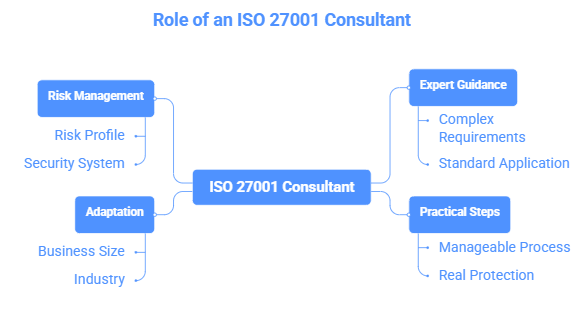
ISO 27001 consulting services provide expert guidance to organizations that want to build a solid Information Security Management System (ISMS). These consultants serve as experienced guides. They take the complex requirements of the standard and turn them into clear, practical steps.
Gap Analysis and ISMS Readiness Assessment
The first big job a good ISO 27001 consultant usually does is a thorough gap analysis. They sit down with your team, review your current security practices, and compare them against the full ISO 27001 standard. They talk to people from different departments, look through existing documents, and sometimes visit your offices or data centres to get a clear picture of how things really work.
This isn’t just a quick checklist. A solid gap analysis gives you an honest view of where you stand today. It highlights exactly what’s missing, what’s partially done, and what’s already working well. From there, the consultant builds a clear roadmap — what needs to be fixed, who should do it, and roughly how long it will take.
Many companies say this step is the most valuable part of the whole journey. It stops you from wasting time and money on things you don’t actually need, and it helps you focus your effort where it matters most. Without it, certification can turn into a long and expensive surprise.
Policy Development Aligned with ISO 27001:2022
Once the gaps are identified, the next step is building the right policies and procedures.
- Good consultants don’t copy templates.
- They create practical policies that actually fit how your business works.
The 2022 version organises the 93 Annex A controls into four clear categories:
- Organizational
- People
- Physical
- Technological
Key documents include:
- Information Security Policy — the only policy specifically required by the standard.
- Access control rules
- Information classification and handling procedures
- Risk management processes
- Business continuity plans
The best consultants make sure these policies are:
- Compliant with the standard
- Easy to understand and follow
- Tailored to your company’s culture and daily operations
They work closely with your team so the documents feel like they belong to you — not something written by outsiders.
Internal Audits and Certification Preparation
Before the official certification audit, a strong consultant will run practice audits with you. These mock audits simulate the real thing. They review your ISMS performance, check your documentation, and help fix any weaknesses before the external auditors arrive. It’s like a dress rehearsal that shows you where you still need to improve.
ISO 27001 also requires you to carry out regular internal audits. Good consultants help you set up a practical audit programme and can even train your own team so you can eventually run these audits yourself.
During the actual certification audit, consultants usually stay in the background. However, they can still support you by preparing evidence and answering technical questions if the auditors need clarification. Many organizations continue working with their consultant even after certification for help with yearly surveillance audits and the three-year recertification.
Independent Consultants vs Consulting Firms
When choosing an ISO 27001 consultant, you basically have two main options: working with an independent consultant or hiring a larger consulting firm. Both can work, but they offer very different experiences.
- Cost Independent consultants usually charge £70–£250 per hour. Larger firms typically charge £150–£500 per hour due to their higher overheads (offices, teams, marketing, etc.).
- Expertise Solo consultants often have deep, specialised knowledge in specific areas of ISO 27001. They can focus closely on your unique risks and tailor the solution to how your business actually operates.
- Approach: Larger firms bring a full team and offer broad coverage across many security topics. They usually provide ready-made service packages, which work well if you want solid, all-round support without heavy customisation.
- Accountability With an independent consultant, responsibility is personal — their reputation is on the line. You know exactly who is accountable. In a firm, work is shared among team members. This gives you wider support, but the personal ownership can sometimes feel less direct.
In the end, there’s no single “best” choice. It depends on your company’s size, budget, timeline, and how complex your risks are. Choose based on what matters most to you: deep personalised expertise or broad team backup.
Key Qualifications to Look for in ISO 27001 Consultants
Choosing the right ISO 27001 consultant makes a big difference. The best ones have the right mix of credentials and real-world experience. Here’s what you should look for:
- Lead Auditor Certification: This shows they’ve been properly trained to audit against the ISO 27001 standard.
- Hands-on Implementation Experience: They should have helped other companies actually build and run an ISMS — not just talk about it.
- Knowledge of Your Industry Look for someone who understands your sector (e.g., SaaS, manufacturing, healthcare, or fintech).
- Familiarity with European Regulations. They need to know how ISO 27001 connects with GDPR, NIS2, and local laws in the UK, Germany, or Italy.
- Clear Communication Skills The consultant should explain things simply and work well with your team — not just use heavy jargon.
- Post-Certification Support: Good consultants stay with you after certification for surveillance audits and ongoing improvements.
The right qualifications go beyond certificates on paper. You want someone who has done this before and can guide you through the real challenges.
ISO 27001 Lead Auditor and Lead Implementer Certifications
When you’re looking for a good ISO 27001 consultant, formal certifications are one of the first things worth checking. The two most important ones are Lead Auditor and Lead Implementer.
Lead Auditor Certification shows that the consultant knows how to properly audit an Information Security Management System (ISMS) against the ISO 27001 standard. It proves they understand both the implementation side and the review process.
To earn this credential, consultants usually need to:
- Complete specialised training on the ISO 27001 standard and auditing principles
- Pass a challenging exam covering seven key competency areas
- Have at least two years of professional experience in information security
- Log a minimum of 200–300 hours of actual audit experience
- Agree to follow a professional code of ethics
Lead Implementer Certification focuses on the practical side — actually building and rolling out an effective ISMS. It demonstrates that the consultant has real experience putting the standard into practice.
This qualification typically requires:
- Completing dedicated Lead Implementer training
- Passing a detailed exam focused on implementation
- At least two years of hands-on experience in information security management
- Documented project work (usually 200–300 hours minimum)
- Commitment to professional ethics
These certifications go far beyond theory. They show that the person has actually done the work — whether auditing or implementing ISO 27001 systems in real organisations.
Experience with ISO 27001:2022 Clause 9.2 Audits
Beyond formal certifications, one of the most important things to look for in an ISO 27001 consultant is real experience with internal audits under Clause 9.2. This clause requires organisations to carry out regular internal audits at planned intervals. The goal is simple: make sure the ISMS is actually working and follows the standard.
Good consultants should be able to show they know how to do this well. Look for someone who has:
- Designed practical audit programmes that check both whether controls are effective and whether the whole system meets the standard
- Run mock audits that feel like the real certification audit, helping teams spot problems early
- Solid knowledge of ISO 19011 and ISO/IEC 17021-1 guidelines
- Experience managing audit teams and handling any disagreements that come up during the process
If a consultant holds a Lead Auditor qualification, that’s usually a strong sign they’ve had proper training in these areas. Their hands-on experience with Clause 9.2 audits is especially valuable because they already know exactly what external auditors will be looking for.
When you speak with potential consultants, ask them to share specific examples of how they’ve helped other organisations with internal audits. The best ones will happily explain their methodology and tell you how they’ve built audit programmes that catch weaknesses before the official certification audit even begins.
Risk Treatment and the 93 Annex A Controls – Consultant Know-How
Risk assessment and treatment are the real heart of ISO 27001. A good consultant needs to know Annex A controls inside out. There are 93 controls, grouped into four simple categories: organizational, people, physical, and technological.
Here are the key points to look for when choosing the right consultant:
- They see the big picture: The best consultants understand how the Statement of Applicability (SoA), risk assessment, and controls fit together as a cohesive system, not just isolated documents.
- They build a tailored SoA: A strong consultant creates a Statement of Applicability that justifies why specific controls were chosen or excluded, rather than just copying a generic list from the standard.
- They link risks to actions: They must know how to map controls directly to your actual risks. If they can’t explain how a control mitigates a specific risk you identified, that’s a red flag.
- They justify exclusions properly: A knowledgeable consultant knows when it is acceptable to exclude a control and, more importantly, how to document that justification so an auditor won’t reject it.
- They ask before they tell: Look for a consultant who asks smart questions about your business operations first. They should adapt the standard to your reality, not force a one-size-fits-all template onto your workflow.
- The “Risk Treatment” test: Ask any candidate how they handle risk treatment planning. Their answer will quickly reveal if they truly understand the core logic of the standard or if they are just checking boxes.
- Test them with a call: Book a short readiness call and focus the conversation on your specific risks. A strong consultant will analyze your processes before suggesting solutions; an average one will start pitching a fixed package.
Why ISO 27001 Matters More in Europe Right Now
The standard itself hasn’t changed much since the 2022 update, but the business environment has.
- UK companies still need to prove strong controls to EU clients after Brexit.
- German firms face stricter scrutiny under GDPR, the NIS2 Directive (especially in critical sectors), and industry-specific rules in automotive, healthcare, and finance.
- Many enterprise clients now require ISO 27001 in tenders and supplier questionnaires.
- Cyber insurance premiums in both countries are noticeably lower for certified organisations.
- GDPR Article 32 (security of processing) doesn’t require certification, but a solid ISMS is one of the best ways to demonstrate “appropriate technical and organisational measures”.
A good consultant doesn’t just help you pass an audit. They help build a system that actually reduces risk.
Step 1 – Start with a Proper Gap Analysis
Every serious ISO 27001 project begins with a gap analysis. This is an independent review that compares your current security practices against the full ISO 27001:2022 standard (Clauses 4–10 and the 93 Annex A controls).
A thorough gap analysis should include:
- Review of existing policies, risk assessments, access controls, and incident processes
- Interviews with staff from IT, HR, operations, and leadership
- Clear identification of quick wins versus major gaps
- A written report with prioritised actions and a timeline estimate
It usually takes 2–5 weeks, depending on company size and complexity.
Warning signs to watch for:
- A “free gap analysis” that’s really just a 45-minute sales call
- No proper written report, only slides
- A fixed-price quote for the full project before they’ve seen your environment
A solid gap analysis is one of the best investments you’ll make. It prevents expensive rework and audit surprises later.
Step 2 – Scope: The Make-or-Break Decision
The scope defines exactly what the certificate will cover. Get this wrong and you’ll either pay too much (scope too wide) or fail the audit (scope too narrow).
Good scope examples in Europe:
- UK SaaS company: “The cloud-based SaaS platform infrastructure (AWS London region) and all supporting development, support, and sales teams in the UK.”
- German manufacturer: “Production control systems, customer data processing, and related IT infrastructure at the Stuttgart and Munich sites.”
- Multi-site fintech: “Information security activities supporting customer-facing applications and primary data centres in Frankfurt and London.”
Practical tips:
- Start narrow if you’re unsure — you can expand the scope later.
- Explicitly include any processing of EU personal data (this helps prove GDPR Article 32 compliance).
- Make sure the consultant spends real time discussing the scope during the gap analysis.
Once the certification body accepts the scope, changing it later becomes costly and time-consuming.
Step 3 – Realistic Timelines (UK vs Germany 2026)
Timelines vary depending on company size and complexity.
Typical timelines:
- Small & well-prepared: 5–8 months
- Typical mid-sized: 8–12 months
- Complex or multi-site: 10–16 months
German projects often run 1–2 months longer due to stricter documentation requirements and auditor availability.
Rough phase breakdown:
- Gap analysis & planning: 4–8 weeks
- Implementation & documentation: 3–6 months
- Internal audit + management review: 4–8 weeks
- Certification body booking + Stage 1: 4–10 weeks wait
- Stage 2 audit: 2–6 weeks after Stage 1
- Certificate issued: 2–4 weeks after Stage 2
Step 4 – The GDPR Connection – A Major Advantage in Europe
Any consultant worth hiring in Europe should clearly explain how ISO 27001 supports GDPR. Clients and authorities will ask.
Key overlaps include:
- ISO Annex A.5–A.8 → GDPR Article 32 (security measures)
- ISO risk assessment → GDPR Article 35 (DPIA triggers)
- ISO incident response → GDPR Articles 33–34 (breach notification)
- ISO leadership & policies → GDPR Article 24 (accountability)
The best consultants build an integrated system that satisfies both standards. This approach can save significant effort compared to running separate projects.
Useful question to ask consultants:
“How many of your recent UK or German clients have used the same ISMS to demonstrate GDPR Article 32 compliance?”
If they can’t give clear examples, they may not specialise in the European market.
Step 5 – Red Flags & Final Decision Checklist
Red flags to watch for:
- “Certified in 2 months guaranteed.”
- Fixed price quoted before gap analysis
- No recent UK or German client references
- “We write everything — you just sign off.”
- No post-certification surveillance support
- Heavy pressure to sign after one call
Decision checklist:
- Recent UK/German case studies in your industry and size
- Clear gap analysis proposal with a written report
- Realistic timeline (minimum 6 months for most companies)
- Transparent pricing breakdown
- Proven experience linking ISO 27001 to GDPR Article 32
- 12+ months of post-cert support included
- References you can actually call
Common Mistakes to Avoid When Choosing an ISO 27001 Consultant
Technical skills aren’t enough. You need the right fit, too. Here are the most common mistakes:
- Ignoring Cultural Fit The consultant must communicate well with your whole team — from IT to the boardroom. Poor fit leads to confusion and delays.
- Choosing Only by Price: The cheapest option often cuts corners. A failed certification can cost you much more later.
- Forgetting Long-Term Support Certification is just the start. Make sure the consultant will support you for surveillance audits and ongoing updates.
Avoid these pitfalls. Pick someone who truly fits your company — not just your budget.
Final Thoughts
Choosing an ISO 27001 consultant isn’t about finding the cheapest quote — it’s about finding someone who understands your business, the European regulatory environment, and how to build a system that lasts beyond the certificate.
The right partner will save you months, tens of thousands of pounds/euros, and a lot of stress. The wrong one will cost you more in rework, delays, and lost opportunities. Take your time, ask hard questions, and trust your gut. If they treat your business like it’s their own, you’re probably in good hands.
Reference article:
https://elevateconsult.com/insights/selecting-the-best-iso-27001-consulting-services-partner/